



AC repair or replacement in Denver is one of the most common calls we get every summer — and it’s also one of the decisions where homeowners are most likely to get steered wrong. A company with a financial interest in replacement will tell you your 10-year-old unit is shot. A tech who just wants to patch things and move on will slap a band-aid on a system that’s costing you money every month. Getting this call right requires honest information, not a sales pitch.
Here’s how to work through it the right way.
Table of Contents
Why Denver’s Climate Makes This Decision Harder Than It Looks
Denver’s Front Range climate puts central air conditioning systems under a specific kind of stress that homeowners in more moderate climates don’t deal with. You’re running your AC hard from late May through mid-September — not the long, grinding seasons of Houston or Phoenix, but a compressed window of intense demand with temperature swings that can hit the upper 90s in the afternoon and drop 30 degrees after a thunderstorm rolls through.
Add to that the hail. Denver leads the country in hail damage claims, and those summer storms don’t just wreck cars and roofs — they dimple condenser fins, crack refrigerant lines, and accelerate corrosion on outdoor units in ways that may not show up until the next cooling season. Altitude also plays a role: at 5,280 feet, refrigerant pressures behave differently than at sea level, and technicians who aren’t dialed in to Front Range conditions can misread a diagnostic.
The result is that Denver AC systems often age faster than the national averages you’ll find in manufacturer literature. When you’re evaluating your options, local context matters.

Air Conditioning Services in the Denver Metro Area
As an HVAC company serving the Denver metro from Longmont to Littleton and Highlands Ranch, JD’s Plumbing, Heating and Air Conditioning handles the full range of heating and air conditioning work — from same-day AC repair and seasonal maintenance to full system replacement and new installation. Whether you need a quick fix on a failing capacitor or a complete cooling system replacement with a matched furnace and air handler, our HVAC professionals bring licensed, NATE-certified expertise to every job.
Many AC problems start with weak airflow or strange noises that homeowners dismiss until the system stops working entirely. If you’re not sure whether what you’re hearing or feeling is a warning sign worth acting on, our breakdown of the 7 warning signs your AC needs immediate attention can help you decide before a minor issue becomes an expensive one
Weak airflow is often the first sign of a dirty filter, a failing blower motor, or collapsing ductwork — all of which are fixable before they escalate. Unusual noises — rattling, grinding, squealing — are the system telling you a component is failing. Denver AC repair can often be completed the same day or the next day when the root cause is identified early. Waiting until August, when every HVAC company in the Denver metro area is booked out, is a much harder position to be in.
When Repair Is Clearly the Right Call
If your system is under ten years old and you’re dealing with a single-component failure, repair almost always wins. Before assuming you need a repair at all, it’s worth asking whether what you’re seeing is actually a maintenance issue — a dirty filter, a coil that needs cleaning, or a thermostat that’s out of calibration. Our guide on whether your AC needs repair or just routine maintenance walks through how to tell the difference before you call anyone.
The parts that commonly go in that window — capacitors, contactors, fan motors — are relatively inexpensive, and a well-matched cooling system in good mechanical condition still has years of efficient service ahead of it.
A capacitor failure, for instance, might run you $150–$300 all-in, including labor. A contactor swap is similar. Even a refrigerant recharge, assuming the leak has been located and repaired rather than just topped off, is reasonable on a younger system. These are normal maintenance repairs, not signs of a failing HVAC system.
What you want from your technician at this point is a clear answer to one question: Is this an isolated failure or part of a pattern? One capacitor on a seven-year-old system is a coincidence. Two capacitors and a fan motor in three summers is the system telling you something. Higher energy bills without a change in usage habits, uneven temperatures or cold spots in rooms that used to be comfortable, and musty odors from the supply vents are all signs the system is losing ground — not just having a bad day. A good tech will give you an honest read without hidden fees or upsell pressure.
For any repair work on your air conditioner, you can review what JD’s covers under our AC repair services.
When Replacement Is the Smarter Move
Age is the biggest factor. Most residential central AC systems have a service life of 15–20 years under normal conditions. In Denver, with hail exposure and the compressed yet intense cooling season, 15 years is a reasonable upper limit before efficiency degrades enough to noticeably affect your monthly bills.
The refrigerant situation adds urgency for older systems. Units manufactured before 2010 likely run on R-22 (Freon), which the EPA phased out of production as of January 2020. R-22 is still legal to use in existing equipment, but supply is constrained, and prices have spiked. If your R-22 system develops a refrigerant leak, you’re looking at expensive recharge costs — and you’re recharging a cooling system that’s already at or past the end of life. That’s money spent extending a system that doesn’t have much runway left.
Signs that a replacement is needed include inconsistent temperatures across rooms, unusual noises from the indoor or outdoor unit, and an HVAC system that runs constantly without meeting demand. Repeated repairs within a short window are another clear signal. If you’ve spent $800 on your AC in the last 18 months and you’re now looking at another $600 repair, that math doesn’t work regardless of the system’s age.
A full HVAC system replacement — including both the outdoor condenser and indoor air handler or coil — costs around $8,200 to $12,400 in the Denver metro area, depending on system size, efficiency rating, and whether ductwork modifications are required. Ductwork and permits can significantly affect HVAC installation costs, particularly in older Denver Metro homes where duct systems haven’t been updated in decades. Getting that number upfront, with a flat-rate quote that covers everything, is non-negotiable.
When the numbers point toward replacement, our AC replacement page covers what that process and replacement options look like.
The 5,000 Rule — and When It Breaks Down
You’ve probably seen the 5,000 rule: multiply the system’s age in years by the repair cost in dollars. If the number exceeds $5,000, lean toward replacement. It’s a decent starting framework, but it has real limitations.
The rule doesn’t account for energy efficiency. An older system running at a SEER rating of 10 or 12 might technically pass the 5,000 test after a cheap repair, but you’re still living with significantly higher energy bills compared to a modern 16 SEER or higher system. In Denver summers, that energy efficiency gap shows up on your Xcel Energy bill every month.
It also doesn’t account for refrigerant type. A $400 repair on a 12-year-old R-22 system scores a 4,800 on the 5,000 scale — technically under the threshold — but you’re still exposed to escalating refrigerant costs and a system that’s not far from retirement anyway.
Use the rule as a starting point, not a verdict.
The Gray Zone: Heating and Cooling Systems Between 10 and 14 Years Old
This is where most Denver homeowners actually land when they call us, and it’s where the decision requires the most nuance. A 12-year-old system isn’t old, but it’s not young either. Whether you repair or replace depends heavily on what’s failing.
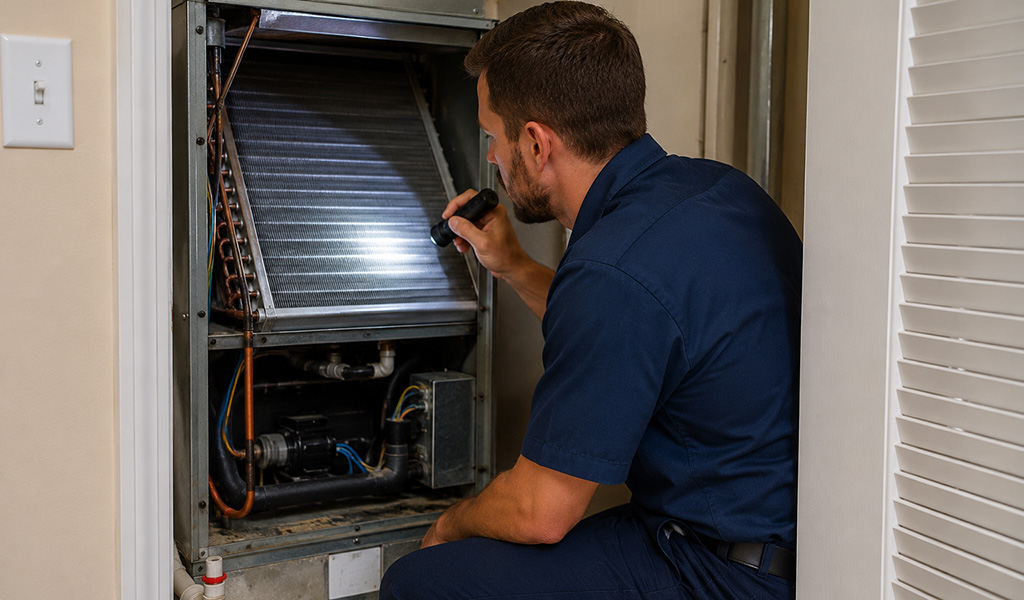
Capacitor or contactor? Repair it — you likely have years left.
Compressor failure? That changes the math entirely. A compressor replacement can run $1,200–$2,500 or more in parts and labor. On a 12-year-old system, you’re spending that money on cooling equipment that may have three to five years of productive life remaining. In most cases, replacement is the right call.
Evaporator coil failure is similar. A new evaporator coil on an aging system is a significant investment, and if the outdoor condenser is also approaching the end of its life, you’re essentially rebuilding a system rather than maintaining one. A matched replacement makes more financial sense.
The age of the indoor and outdoor components also matters. Split systems — which are what most Denver homes have — work best when the indoor air handler or coil and the outdoor condenser are properly matched and roughly the same age. Replacing just one half of a mismatched system can create efficiency problems and void equipment warranties. A technician who doesn’t bring this up during a replacement quote is either cutting corners or hoping you don’t notice.
Ductless systems are worth considering during this evaluation, particularly if you have rooms with persistent hot and cold spots or areas of the home that your central system doesn’t reach well. A ductless mini-split can eliminate hot and cold spots that a conventional line unit struggles to address, especially in home additions, finished basements, or upper floors with poor duct distribution.
Our HVAC services page provides you a fuller picture of what a complete system evaluation covers.
What a Legitimate Estimate Looks Like
Flat-rate pricing is the baseline for honest HVAC work. No hidden fees, no hourly billing that rewards slow techs. A proper diagnostic visit should include a full system inspection: refrigerant pressure check, electrical component test, coil condition assessment, thermostat verification, and airflow measurement. Not a quick look at the outdoor unit and a recommendation to replace. If a tech quotes you a replacement after five minutes on-site without running diagnostics, that’s a red flag.
Watch also for upselling patterns. There’s a difference between a contractor who says “this repair makes sense, but I want you to know the system is aging and we should keep an eye on it” and one who uses every service call as an opportunity to push a new system regardless of the actual condition. The former is advising you. The latter is selling. Great customer service means presenting you with multiple options and letting you make an informed decision.
At JD’s, we’ve been doing honest flat-rate heating and air conditioning work in the Denver Metro since 2007. Our HVAC professionals are licensed, NATE-certified, and back every installation with a 12-year parts-and-labor warranty. We handle emergency repairs when your system goes down mid-summer and routine maintenance services when you want to stay ahead of problems — and we treat customer satisfaction as the standard, not a differentiator. Contact us first, and you won’t need a second opinion.

Heating and Air Conditioning: The Case for Routine Maintenance
The best way to extend the life of your HVAC system — and to delay the repair-or-replacement conversation as long as possible — is consistent seasonal maintenance. Most AC failures that turn into expensive emergency calls started as small, detectable problems. A dirty evaporator coil reduces efficiency and strains the compressor. Clogged HVAC filters restrict airflow, causing the system to run longer cycles. Dust buildup on blower components reduces airflow and accelerates wear. None of these is catastrophic on its own, but left unaddressed, they compound.
Routine maintenance also gives your technician the chance to catch early failure signals — a capacitor that’s weakening, a refrigerant charge that’s drifted, a contactor showing pitting — before they cause a system shutdown. A local heating and cooling company that knows your equipment and maintains its records is a genuine asset throughout the life of your system.
Schedule service before the season starts rather than when the first heat wave hits. AC maintenance in late April or early May means you’re not competing with everyone else in the Denver metro when demand spikes.
If indoor air quality is a concern alongside cooling performance, consider what routine HVAC maintenance addresses. Duct cleaning removes accumulated dust and debris that recirculates through your home. Air purifiers and electronic air cleaners can improve indoor air quality beyond what standard filtration provides — particularly relevant in Denver’s dry climate, where dust and allergen loads are high. If you’re noticing musty odors from supply vents, addressing duct cleanliness and filtration as part of your system evaluation will meaningfully improve indoor air quality.
Our air purification services and electronic air cleaners are worth exploring if your current system isn’t addressing air quality alongside cooling.
Financial Incentives for Replacement in 2026
If replacement is the right call, the financial case has gotten stronger — particularly if you’re open to a heat pump rather than a straight AC replacement.
As of 2026, Xcel Energy has shifted its residential rebate program almost entirely toward heat pumps and electrification upgrades. Standard central AC replacement no longer qualifies for a direct Xcel rebate. However, if you replace your AC with a qualifying cold-climate heat pump, you can access significant incentives: Xcel’s rebate program for cold-climate air-source heat pumps runs up to $2,250 per ton for Xcel gas customers, and the Colorado state heat pump tax credit adds $1,000 at the time of installation with no income requirement. Income-qualified households may also be eligible for the federal HEAR program, which can cover up to $8,000 for eligible heat pump installations.
For a 3-ton system, these programs can substantially reduce the out-of-pocket cost — in many cases, bringing a heat pump installation close to the cost of a new furnace and AC replacement, with no rebates at all. If you’re weighing whether a heat pump is the right replacement, our heat pump vs. central AC breakdown covers how the two systems compare in cost, efficiency, and real-world performance in Denver’s climate. And if you’re also due for a new furnace, combining heating and cooling replacement into a single heat pump installation may make strong financial sense.
Even if you’re staying with a conventional AC system, the efficiency gains from a high-SEER2 unit will show up on your summer bills. Energy Star maintains certification standards and efficiency benchmarks for central AC equipment worth reviewing before you commit to a specific unit.
For complete information on heat pump options as a replacement path, our Denver heat pumps page covers the technology, installation process, and what to expect in Colorado’s climate.
Choosing the Right HVAC Company in Denver
This matters as much as the equipment decision. A poorly installed high-efficiency system will underperform a correctly installed mid-efficiency one every time.
NATE certification is the industry standard for HVAC technician competency. It requires demonstrated real-world knowledge and at least two years of practical experience — it’s not a training certificate you pick up in a weekend. When your technician is NATE-certified, you have independent verification that they know what they’re doing, not just the HVAC company’s word for it.
Proper sizing is the other critical factor. A legitimate installation starts with a Manual J load calculation — a room-by-room analysis of your home’s cooling load based on insulation, window area, orientation, and square footage. Contractors who size by rule of thumb are guessing, and oversized systems short-cycle, fail to dehumidify properly, and wear out faster than correctly sized equipment.
Ask about licensing and insurance in Colorado before anyone opens a panel or touches refrigerant lines. Ask whether they pull permits. Ductwork and permits are part of a legitimate installation, not optional extras. A great company will answer these questions without hesitation on the first call.
Note that swamp coolers (evaporative coolers) are a separate category — they’re common in drier parts of the Colorado Front Range and follow entirely different service and replacement logic than central AC or heat pump systems. If you have an evaporative cooler rather than a refrigerant-based cooling system, make sure the company you call specializes in that equipment.
If you’re in Denver, Westminster, Thornton, Northglenn, Arvada, Highlands Ranch, or anywhere in the Denver metro from Longmont to Littleton, call JD’s at (720) 735-9170 to schedule service today. We’ll tell you exactly what your system needs — nothing more, nothing less.

FAQ-AC Repair or Replacement
How long does a central AC unit last in Denver?
Most central AC systems have a service life of 15–20 years under standard conditions, but Denver’s hail exposure, temperature swings, and a compressed yet intense cooling season can shorten that lifespan. Systems that have sustained hail damage, run on the phased-out R-22 refrigerant, or have a history of deferred maintenance often show meaningful efficiency degradation by year 12–14.
Is it worth repairing an AC unit that’s 12 years old?
It depends on what’s failing. Single-component repairs, such as a capacitor, contactor, or fan motor, on a 12-year-old system generally make sense. Major component failures — particularly a compressor or evaporator coil — start to tip the math toward replacement, since you’re making a large investment in a system approaching the end of its efficient service life.
What is the 5,000 rule for AC repair vs. replacement?
The 5,000 rule multiplies the system’s age in years by the repair cost in dollars. If the result exceeds $5,000, most industry guidance leans toward replacement. It’s a useful starting framework, but has limits — it doesn’t factor in refrigerant type, current efficiency levels, or whether the upcoming repair addresses a systemic problem or an isolated component failure.
How much does AC replacement cost in Denver?
A standard central AC replacement in Denver typically ranges from $4,000 to $8,000, depending on system size and efficiency. A full HVAC system replacement runs around $8,200 to $12,400 when both the indoor and outdoor components are replaced together. Ductwork modifications and permits can affect the final cost. Always get a flat-rate quote that covers all HVAC work before committing.
Does Xcel Energy offer rebates for AC replacement in Denver?
As of 2026, Xcel no longer offers rebates for standard central AC replacement. However, replacing your AC with a qualifying cold-climate heat pump makes you eligible for Xcel rebates up to $2,250 per ton for Xcel gas customers, plus the Colorado state heat pump tax credit of $1,000 at installation, with no income requirement. Income-qualified households may also access the federal HEAR program for additional savings.