



If you’ve called a contractor about an AC issue recently and heard the words “R-410A refrigerant phase-out,” you’re not alone. Across Federal Heights, Westminster, Thornton, Arvada, and the rest of the Denver Metro area, homeowners and property managers are starting to ask the same question: Does this mean my air conditioner is about to become obsolete? The short answer is no, but there’s a lot of nuance worth understanding, especially if you’re weighing a repair vs a replacement this summer.
Table of Contents
What Is the R-410A Refrigerant Phase-Out?
R-410A has been the standard refrigerant in residential air conditioners and heat pumps for roughly two decades, replacing the older R-22 and other older refrigerants that were phased out starting in the 2010s under the Montreal Protocol’s broader push to eliminate ozone-depleting substances. R-410A itself has zero ozone depletion potential — it was actually the industry’s response to that earlier phase-out — but it carries a high global warming potential (GWP), which is the issue driving the current transition.
Under the EPA’s American Innovation and Manufacturing (AIM) Act, the federal government is now phasing down high-GWP refrigerants such as R-410A in favor of alternative refrigerants with a much smaller environmental impact.
As of January 1, 2025, manufacturers stopped producing most new residential air conditioners and heat pump systems that use R-410A. New HVAC systems must now use refrigerants with a GWP below 700 — a significant drop from R-410A’s GWP of roughly 2,088. The EPA extended the installation deadline for R-410A systems built or imported before that date for residential and light commercial units to December 31, 2025. In practical terms, new R-410A equipment has largely exited the supply chain for new installations, and the HVAC industry has shifted to next-generation refrigerants for all future manufacturing.
You can read the underlying regulatory framework directly from the EPA’s AIM Act program, which directs an 85 percent phasedown of HFC production and consumption by 2035. Carrier Enterprisesenate
If that sounds like a hard deadline to panic over, take a breath — it isn’t.
Why This Matters for Your Denver Home or Property
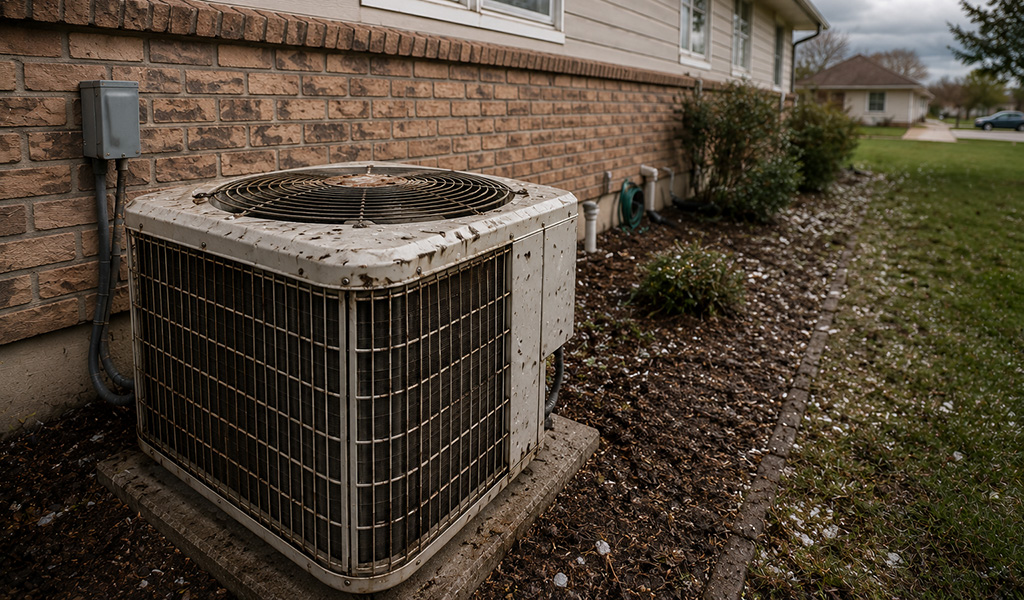
Denver’s housing stock skews older in many of our service areas — Federal Heights, Northglenn, and parts of Thornton have plenty of homes with HVAC systems installed in the 2000s and 2010s, many of which run on R-410A. Add in our hailstorms, which routinely take out condenser coils and fan motors on rooftop and pad-mounted units, and you’ve got many systems that will need refrigerant-related repairs in the coming years.
The refrigerant phase-out doesn’t mean your existing equipment is suddenly illegal to use or repair. There’s no requirement to convert existing HVAC systems to new refrigerants, and equipment manufactured before the cutoff dates can continue operating with R-410A for the life of the unit as long as the refrigerant remains available.
What it does mean is that the refrigerant landscape is shifting under your feet, and that shift affects cost, availability, and your repair-versus-replace math going forward — particularly across different properties in the metro with varying equipment ages, from newer construction in Thornton to older ranch-style homes in Federal Heights and Northglenn. Shareddocs
Can You Still Get R-410A for Repairs?
Yes — for now, and likely for years to come. The sales restriction on new equipment does not apply to components like compressors and coils used to repair existing systems, which can continue to be manufactured and sold indefinitely. Reclaimed refrigerant also remains a legitimate, EPA-supported pathway for servicing older central AC units, since recovery and reclamation are central to the agency’s approach to managing the existing refrigerant supply during the transition. ACHR News
One important clarification: the EPA restricts R-410A sales to certified technicians only, under the same Section 608 framework that has governed refrigerant handling for years. You can’t walk into a supply house and buy a jug of R-410A without EPA certification — which is part of why working with a licensed HVAC contractor matters now more than ever, both for legal compliance and for making sure your system is charged correctly with an increasingly valuable refrigerant.
What’s changing is price and availability. While R-410A remains available for servicing existing equipment, supply is already tightening, with prices increasing following production cutbacks. If your 12-year-old AC needs a refrigerant top-off or a coil replacement this summer, expect that line item on your invoice to cost more than it did three or four years ago — and expect that trend to continue. If your system is humming along fine, there’s no reason to rip it out. If it’s already on its last legs and needs a major component repair, it’s a factor worth weighing.
Our team handles AC repairs throughout the Denver Metro and can give you a straight answer on whether a repair still makes sense for your specific unit. OXMaint

What’s Replacing R-410A? R-454B and R-32
The new standard taking over for most residential air conditioning systems is R-454B, marketed by Carrier as Puron Advance and known by other trade names and brand names depending on the manufacturer — some call their version by names derived from Freon, a legacy trademark that’s stuck around in everyday language even though true Freon refrigerants were phased out years ago. R-454B offers a 78% lower global warming potential than R-410A while maintaining comparable performance, and it carries a GWP of 466 compared to R-410A’s 2,088. Most major manufacturers — Carrier, Trane, Lennox, Daikin, Mitsubishi Electric — have moved to R-454B or similar low-GWP blends for their current product lines, reflecting industry leadership on environmental impact across the board. CarrieriFactory
One important technical detail: these new refrigerants are classified as A2L, meaning they’re mildly flammable, unlike R-410A. R-410A cannot simply be swapped for R-454B in an existing unit — the equipment itself is engineered differently for the new refrigerant, with different components, charge levels, and safety protocols built in at the factory.
Always check your owner’s manual before assuming any refrigerant substitution is safe or even possible; mismatched refrigerants can damage a compressor and void your warranty outright. That’s why our HVAC technicians have undergone proper training specific to A2L refrigerant handling, in addition to the universal EPA Section 608 certification every tech is required to hold. It’s not a drastic change to how systems get serviced, but it does require updated tools, gauges, and leak-detection equipment, and a tech who actually knows what they’re doing with the new chemistry.
Worth noting for anyone following this from a broader perspective: similar refrigerant requirements have been rolling out internationally, with the European Union pursuing its own F-Gas regulations on a parallel timeline — so this isn’t a uniquely American shift, it’s part of a global move away from older refrigerants toward lower-GWP alternatives.

Repair or Replace? How the Phase-Out Affects the Decision
This is where the phase-out actually becomes relevant to your wallet. If you’ve got an AC unit that’s 12 to 15 years old and it needs a major repair — a failed compressor, a leaking coil, anything that requires a significant refrigerant charge — you’re now looking at expensive repairs on a system that’s already past or near the end of its expected service life, using a refrigerant that only gets pricier from here.
In that situation, putting a few thousand dollars into an aging R-410A system often doesn’t make sense when a new HVAC system running on R-454B would come with better efficiency, a full warranty, and refrigerant costs that are heading in the right direction instead of the wrong one. We back every new system we install with a 12-year parts and labor warranty, which takes a lot of the risk out of that decision — you’re not betting on refrigerant prices or part availability five years down the road, and you save money on both the install and the years of ownership that follow.
On the other hand, if your system is younger, well-maintained, and the repair is relatively minor — a capacitor, a contactor, a small leak — there’s no reason to rush into a replacement just because of headlines about refrigerant. Our AC replacement page walks through the bigger-picture factors we weigh with customers, but the short version is: age, repair cost relative to replacement cost, and how much longer you realistically want to rely on the current unit.

What This Means If You’re Buying, Selling, or Managing Rental Property in Denver
If you’re a landlord or commercial property owner in the Denver Metro, the refrigerant transition is worth building into your capital planning. Properties with older HVAC units aren’t suddenly non-compliant, but as those systems age toward end-of-life, replacement parts and refrigerant servicing will represent a growing line item. For multi-unit properties or commercial buildings with several rooftop units, that can add up fast, especially since larger systems over 65,000 BTU have their own separate installation timeline that differs from residential equipment. Carrier Enterprise
If you’re evaluating a property purchase, it’s worth knowing the approximate age and refrigerant type of the HVAC equipment as part of your due diligence — a property with multiple aging R-410A rooftop units represents real future expense, even if everything is currently functioning. For commercial property owners managing HVAC across several buildings, our commercial plumbing and HVAC team can help assess where you stand and build a realistic replacement schedule rather than getting caught flat-footed by simultaneous failures.
Rebates and Incentives for Upgrading Now
If the phase-out has you considering an upgrade sooner rather than later, Colorado’s rebate landscape makes the timing better than it’s been in years. Xcel Energy’s cold-climate heat pump rebate pays $2,250 per heating ton for systems that maintain at least 70% capacity at 5°F — which is the category most Denver-area homes fall into, given our winters. Standard ducted heat pumps qualify for $900 per cooling ton, and these rebates are typically applied as an upfront discount rather than a reimbursement you wait months for. UnicoloradoUnicolorado
For homeowners specifically weighing a straight AC replacement against a heat pump that handles both heating and cooling, the rebate math can shift the calculation considerably — a heat pump upgrade that also replaces an aging furnace can stack rebates in a way a like-for-like AC swap can’t. It’s worth a conversation before you decide which direction to go, particularly if your furnace is roughly the same age as your AC and both are approaching replacement territory anyway.
How JD’s Can Help You Navigate the Refrigerant Transition
Refrigerant regulations are the kind of thing that’s easy to half-understand from a headline and then either panic unnecessarily or miss something that actually matters for your situation. Our NATE-certified technicians stay current on both the regulatory and hands-on sides — what’s actually changing in the equipment, what it means for servicing your specific system, and what your realistic options are.
If your AC is struggling and you’re not sure whether it’s worth fixing given everything happening with refrigerants, start with our AC maintenance and diagnostic service. We’ll give you flat-rate pricing up front, an honest read on your system’s condition, and — if replacement makes more sense — a clear picture of what a new system costs after applicable rebates. Contact us at (720) 735-9170 to get on the schedule.

Is R-410A Refrigerant Being Banned Outright?
No. The phase-out restricts manufacturing of new equipment that uses R-410A, but it doesn’t ban the refrigerant itself or make existing systems illegal to operate or repair. Existing R-410A systems can continue to run and be serviced for the rest of their useful life.
Will My Air Conditioner Stop Working Because of the Refrigerant Phase-Out?
No. Your system will keep operating exactly as it does now. The phase-out affects what’s being manufactured going forward, not the legality or function of equipment you already own.
Is It Illegal for a Technician to Repair My R-410A System in Colorado?
No. Technicians can still service, recharge, and repair R-410A systems using reclaimed or recycled refrigerant, and replacement parts for these systems remain available. What’s changing is cost and long-term availability, not legality.
How Much More Expensive Is R-410A Getting?
Prices have been climbing as production caps tighten supply, and that trend is expected to continue over the next several years. The exact cost depends on market conditions at the time of service, which is one reason we always provide flat-rate pricing so you know the cost before work begins.
Should I Replace My AC Before It Breaks Just Because of This Refrigerant Phase-Out?
Not necessarily. If your system is relatively new and well-maintained, there’s no urgency. If it’s already older and showing signs of trouble, the phase-out is one more factor — alongside age, efficiency, and current rebate availability — that can tip the scales toward replacing proactively rather than waiting for a costly emergency repair.