



How much does AC repair cost in Denver? Most jobs run somewhere between $150 and $800, with the bulk of calls landing in the $250–$450 range. A blown capacitor is a quick, inexpensive fix. A failed compressor is a different conversation entirely, and it’s the kind of repair that starts pushing homeowners toward replacement math. The honest answer always depends on which part failed, how old your system is, and whether you’re calling in July when every HVAC company in the metro is booked solid. That’s the range you’ll see across most Denver air conditioning repair calls, whether you’re a homeowner, a landlord managing a rental, or a property manager overseeing a commercial building.
We’ve been running trucks through Federal Heights, Northglenn, Westminster, Thornton, and Arvada since 2007, and the price swings we see aren’t random. They follow patterns tied to what’s actually broken, what refrigerant your system runs on, and how well the unit’s been maintained. Here’s what actually drives the number on your invoice.
Table of Contents
How Much Does AC Repair Cost in Denver: The Quick Answer
If you searched for AC repair cost Denver because your system just quit, here’s the fast version before we get into specifics: most repairs run $150 to $800, hourly labor for Denver AC repair typically falls between $75 and $200, and a diagnostic visit is often waived if you move forward with the recommended repair. From there, the exact number depends on what actually failed.
What Determines Your AC Repair Cost
The single biggest factor is the failed part itself. A capacitor or a contactor is a 30-minute fix with an inexpensive component behind it. A compressor, an evaporator coil, or a refrigerant leak deep in the line set is a different job — more labor, more diagnostic time, and parts that cost real money. Third-party sources that track pricing nationally sometimes cite AC repair costs across the Denver metro area as wide as $138 to $2,116 — a range that reflects everything from a simple capacitor swap to a full compressor replacement, not a typical single repair, so treat it as an outer boundary rather than an expected number.
Refrigerant type matters more than most homeowners realize. If your system was installed before 2010, it may still run on R-22, which hasn’t been produced domestically in years and now trades at a steep premium when it’s available at all. Newer systems run on R-410A, which is itself being phased down under EPA regulations, meaning recharge costs for that refrigerant will climb over the next several years, too. We’ve written a full breakdown of what that phase-out actually means for your system and your wallet if you want the detail — see our R-410A refrigerant phase-out guide.
Accessibility plays a role as well. A condenser sitting in an open side yard is a faster job than one wedged behind a fence, buried under a deck, or — as we see constantly in older North Denver neighborhoods — installed in a cramped mechanical closet with no clearance. And then there’s timing. Call in February, and you’ll likely get same-day service at standard rates. Call during a 95-degree stretch in July, and you’re competing with every other homeowner in the Denver Metro for the same limited number of trucks, which often means longer waits and, with some companies, higher emergency rates.

Common AC Repairs and What They Typically Cost
A failed run or start capacitor is one of the most common summer calls we get, and it typically costs $150 to $400 to install. It’s a small part that takes the brunt of the electrical load every time your system cycles on, so it wears out on a predictable schedule, especially on units eight-plus years old.
A refrigerant leak repair and recharge can range widely, generally $200 to $1,500 or more, and the spread comes almost entirely from the refrigerant type and leak location. A small leak in an accessible line on an R-410A system is on the low end. A leak that requires opening up the coil, or a system still running R-22, pushes toward the top.
Compressor replacement is the big one — usually $600 to $2,500, depending on the unit’s size and brand. The compressor is the heart of the system, and when it fails on an older unit, it’s often the point where we start talking replacement instead of repair, because you’re putting a significant repair bill into equipment that may only have a few cooling seasons left. If you’re weighing that decision right now, we’ve laid out the actual math in our AC repair or replacement guide, and our earlier piece on diagnosing a failing AC compressor covers the warning signs before it fully gives out.
A failed fan motor — either the condenser fan outside or the blower fan inside — typically runs $300 to $700. Thermostat and control board issues land in the $150 to $600 range depending on whether it’s a simple thermostat swap or a board-level electrical problem. And a clogged condensate drain line, which is one of the most common “my AC just stopped working” calls we get in humid stretches, is usually a $100 to $250 fix — often less if caught before it trips the safety switch and shuts the whole system down.
Common AC Problems in Denver Homes
Before you get to a repair bill, most central AC problems in Denver homes show up as one of a handful of recognizable symptoms, and each one points toward a different corner of the system. Warm air coming from the vents instead of cool air usually means one of three things: low refrigerant, a failing compressor, or a dirty air filter restricting airflow so badly the coil ices over.
Short cycling — the system turning on and off in rapid bursts instead of running a full cooling cycle — often points to the system’s electrical needs, like a failing capacitor or start relay, or a unit that was oversized for the home to begin with, and it puts extra wear on the compressor every time it happens. It’s the same principle that causes a furnace to short-cycle during the heating season, just on the cooling side of the same system.
A clogged drain line is one of the most common calls we get, especially in older homes with PVC condensate lines that build up algae and sediment over years of use; left alone, it backs up and trips the safety float switch, shutting the whole system down. Refrigerant issues — whether a slow leak or a system that was undercharged during a prior repair — show up as warm air, ice on the line set, or a system that runs constantly without ever reaching the thermostat’s set point. A good technician doesn’t just treat the symptom; finding the root cause is what keeps you from paying for the same repair twice in one summer.
Why AC Repair Costs More (or Less) in the Denver Metro
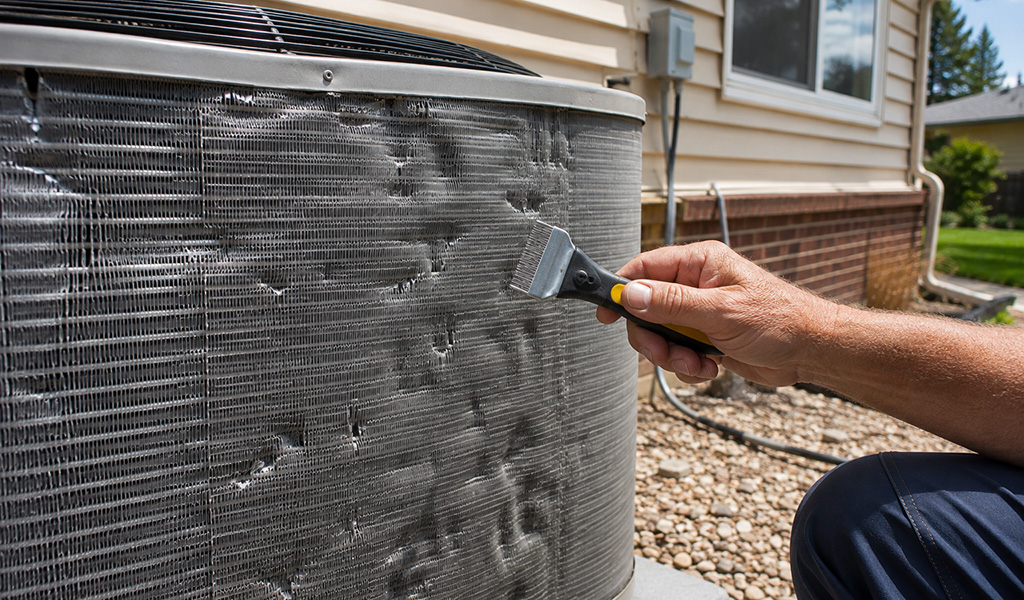
Denver’s Front Range climate puts a specific kind of stress on cooling systems that homeowners moving here from milder climates aren’t used to. Big daily temperature swings mean your air conditioner cycles harder than it would in a more consistent climate, and that accelerates wear on capacitors, contactors, and fan motors.
Hail is the other regional factor that doesn’t show up in national cost guides. A single significant hailstorm can dent condenser fins badly enough to restrict airflow and force the compressor to work overtime, and we see a real spike in condenser coil and fan repairs every year after a bad storm rolls through the metro. If your system took hail damage, check with your homeowners insurance before you pay out of pocket — that’s frequently a covered claim.
Add in the age of the housing stock across Federal Heights, Northglenn, Thornton, and the surrounding suburbs, where a lot of HVAC equipment dates to the 2000s and 2010s, and you’ve got a real population of R-410A and even some remaining R-22 systems reaching the age where repairs get both more frequent and more expensive.
Repair Cost vs. Replacement Cost — When the Math Flips
There’s a rough rule of thumb worth knowing: if a repair costs more than 50% of what a new system would cost, or your unit is past 12–15 years old and needing its second or third repair in a couple of years, replacement usually wins out financially. A $1,500 compressor repair on a 14-year-old R-410A unit is a harder sell than the same repair on a 5-year-old system.
We won’t try to talk you into a repair or a replacement based on which one pads a bill — we’ll walk you through the actual numbers for your specific system and let you make the call. If you want the full breakdown of that decision, our AC repair or replacement guide covers it in depth.
AC Replacement Cost in Denver: What a New System Runs
When repair no longer makes sense, the next question is what a new AC system actually costs to install across the Denver area. Pricing varies based on your home’s size, the brand you choose, and the extent of work required beyond simply swapping the outdoor unit.
A basic AC replacement — a straightforward like-for-like swap on a smaller single-stage system with no ductwork changes — can run as low as $3,306. Many homeowners land in a broader $6,000 to $11,000 range once you account for a properly sized central AC system, a new indoor coil, and standard installation labor. If your furnace is nearing the end of its life and you’re replacing both the AC and the furnace, the total cost can exceed $15,000 — though pairing the two jobs in one visit typically saves on labor compared to two separate installations down the road.
Several factors drive where you land in that range. System size matters — AC systems are sized in tons of cooling capacity, and an undersized unit will short cycle and struggle to keep up on Denver’s hottest days, while an oversized one wastes energy and wears out faster.
Efficiency rating is another factor: a higher-SEER new AC system costs more upfront but lowers utility bills over the life of the unit. Major AC brands — Carrier, Trane, Lennox, Rheem — price differently, and installation complexity (attic access, electrical panel upgrades, ductwork modifications) can add meaningfully to labor costs.
We offer financing options for homeowners who’d rather spread the total cost of a new unit over time than pay upfront, and every replacement quote includes an upfront estimate before work begins — no surprises once the crew is on site. Whatever system you land on, keeping up with annual maintenance afterward is what keeps a new unit delivering its best performance for the long haul, from Federal Heights down through Denver, CO and out to Greenwood Village and Littleton.
If replacement turns out to be the right call, our AC replacement team can walk you through sizing, brand options, and financing specifics for your home.
How to Avoid Overpaying for AC Repair in Denver

Flat-rate, upfront pricing is the single biggest protection you have. When a company quotes you a price before the work starts — not an hourly rate that can balloon once they’re inside your unit — you know exactly what you’re paying regardless of how long the job actually takes. That’s how we’ve priced every job since 2007.
It also helps to know what’s typical industry-wide, even though it can’t replace an actual quote for your system: hourly labor rates for HVAC technicians in the Denver area typically range from $75 to $200, and emergency or after-hours service fees can add another $50 to $100 per hour on top of standard rates. Many local HVAC companies, JD’s included, will waive the diagnostic fee if you move forward with the recommended repair, so it’s worth asking before you agree to a standalone diagnostic charge.
Be cautious of a technician who diagnoses a compressor failure in under two minutes without actually testing it, or who pushes hard for full system replacement on a unit that’s had one prior repair. A legitimate diagnosis takes time and involves actually checking refrigerant pressures, electrical readings, and airflow — not just listening to the unit run for thirty seconds. Working with NATE-certified technicians is one of the better safeguards here, since that certification requires demonstrated, tested knowledge of these systems rather than just a truck and a toolbox.
It’s also worth asking what warranty backs the repair itself. We back our work with a 12-year parts-and-labor warranty, which means a repair isn’t just a patch — it’s backed the same way a new installation would be. Regular annual maintenance is the cheapest insurance against a big repair bill in the first place; a $75–$150 tune-up catches a weak capacitor or a dirty coil before it turns into a mid-July no-cool emergency. Our AC maintenance service covers exactly that.

When to Call a Professional vs. When It’s a Quick Fix
Before you call anyone, check the basics. A tripped breaker, a dead thermostat battery, or an air filter so clogged it’s choking airflow can all mimic a “broken AC” without actually being a mechanical failure — and none of them cost a repair bill to fix. If the outdoor unit isn’t running at all, check the breaker first. If it’s running but not cooling, a dirty filter or blocked return vent is worth ruling out before you assume the worst.
Anything beyond that — strange noises, ice on the refrigerant lines, water pooling near the indoor unit, or a system that runs constantly without ever reaching your set temperature — is a call for professional service from a licensed technician. Our AC repair team serves Federal Heights, Northglenn, Westminster, Thornton, Arvada, and the greater Denver Metro. Call us at (720) 735-9170, and we’ll give you a straight answer either way.
How much does it cost to fix an AC that’s not cooling?
It depends entirely on the cause. A dirty filter or tripped breaker costs nothing. A capacitor runs $150–$400. A refrigerant leak or compressor issue can cost anywhere from $200 to $2,500, which is why a diagnostic visit matters more than guessing from symptoms alone.
Is it worth repairing an AC unit that’s 10+ years old?
Sometimes — it depends on the specific repair and the system’s overall condition. A minor repair, like a capacitor, is almost always worth it, regardless of age. A major repair, like a compressor on a 12+ year-old system, usually isn’t, since you’d be investing significant money in equipment nearing the end of its expected lifespan.
Does homeowners insurance ever cover AC repair costs?
Occasionally, yes — particularly if the damage resulted from a covered event like hail, lightning, or a burst pipe that flooded the unit. Normal wear-and-tear failures, such as a worn capacitor or an aging compressor, typically aren’t covered. It’s worth a quick call to your insurer if a storm preceded the failure.
How much does an emergency or same-day AC repair cost in Denver?
Emergency and after-hours service can carry a surcharge with some companies, often an extra $50 to $100 per hour on top of standard labor rates, particularly during peak summer demand when technicians are stretched thin across the metro. Ask upfront whether same-day service comes with an added fee before you schedule.
What’s the average cost of an AC tune-up vs. a repair?
A routine AC tune-up typically runs $75–$150 and covers cleaning, a refrigerant check, and an inspection of electrical components. A repair addresses an actual failure and can range from $150 for a simple part to well over $1,000 for a major component. Regular tune-ups are the best way to keep repair costs on the low end of that range.